


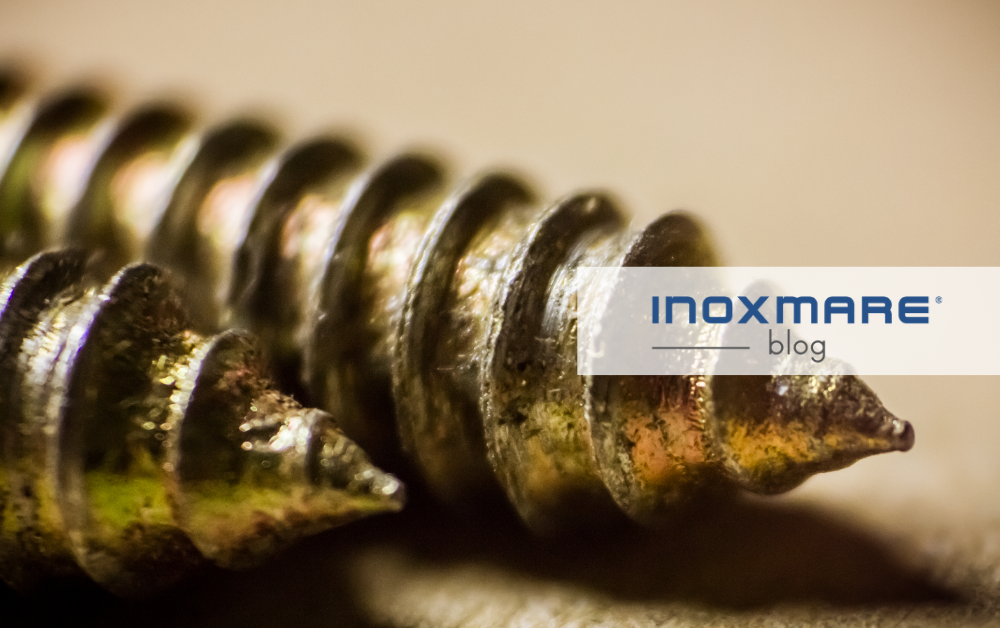
Usually, screws, bolts and nuts have single threads. However, there are double-threaded (or triple-threaded) components that provide an advance equal to twice (or three times) the pitch, respectively. It is possible to differentiate the various types of threads required by standards for the profile shape. The latter, in fact, are intended to fulfil functional requirements and application.
What are the types of threads?
There are three most frequently used standard shapes of thread. These are:
- triangular threads
- square threads
- trapezoidal threads.

You can see them above in more detail. The triangular thread is mainly used as a “connection“; in this case, the angle between the threads is 60° and the crest of the thread can be flat or rounded. The other two types of threads (square and trapezoidal) are used for the transmission of torque (or power). Trapezoidal threads, for example, are subject to change with frequency. The angle between threads, in this case, changes from 10° to 15°, decreasing the space between teeth. It is thus able to achieve greater efficiency. Here some examples: the lathe spindle nuts or the mechanically driven machine tools screws.
Which elements characterize the thread?
The thread is characterized by several key elements:
- nominal diameter
- thread pitch
- toward of helix.
Moreover, the standard thread dimensions are:
- metric standard and fine M threads (in millimeters)
- Whitworth W threads (in inch)
- Gas threads (in inch).
Thread designation
What are the thread designations?
- side symbol (that identifies the thread)
- nominal diameter, in millimeters or inch (screw external diameter)
- pitch, in millimeters (if different from that nominal diameter)
- principle numbers (if higher than one)
- toward helix (if left).
Find our webshop!
Click on the link below to access our web shop. You can choose the most suitable items to your customers needs.
Want to read more? Click here