


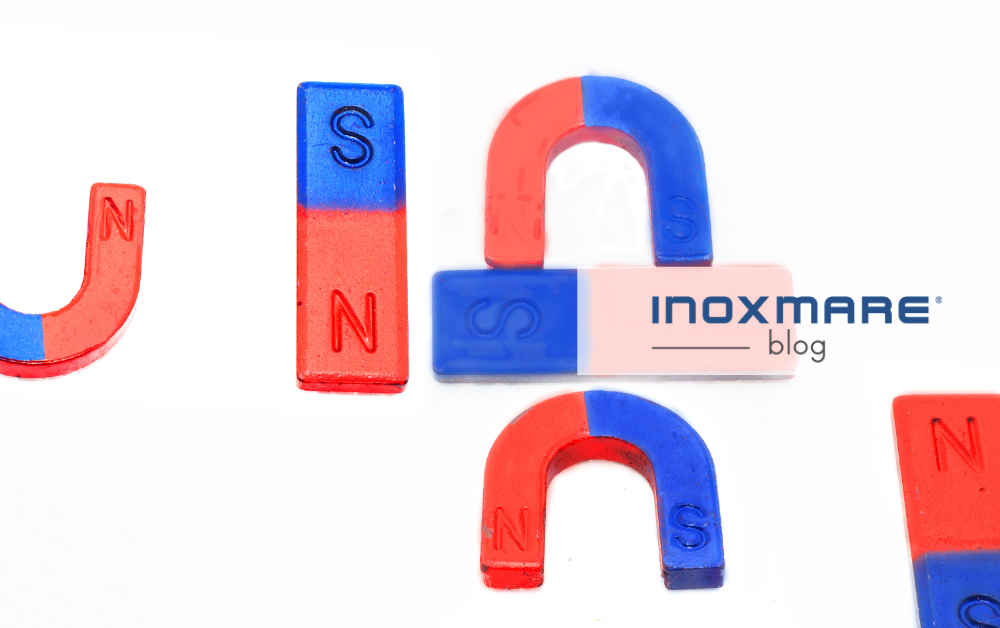
One of the most common doubts that blog readers share with us is that of the magnetism of steels. The last question refers to the case of an stainless steel AISI 316L amagnetic gas detector container to which a magnet was attached.
Is the stainless steel AISI 316L amagnetic? What does our expert say?
The whole family of austenitic and, in particular, stainless steel AISI 316L, are by definition amagnetic. But actually, this type of stainless steel can have a slight magnetism. The latter is due to the processing through which the artifacts in this material are made. Any examples?
We talk about processing as
- plating
- wire-drawing
- moulding
- extruding
- etc..
These processes, in fact, work-harden the material, increasing its hardness, with the consequence of inducing a more or less accentuated magnetism.
The permeability of stainless steel
Stainless steel, like any other material, can also be defined based on its magnetible capacity: only the vacuum is, in all likelihood, the only completely amagnetic element. The measure of permeability of the material in a magnetic field is given by the magnetic permeability value (indicated with µr) of that material, with respect to the vacuum. The material has a reduced magnetic permeability, but this is only when it is close to the value 1. In our specific case: A4=µ ~1,015.
In conclusion
In this particular case, the fact that the gas detector container has a slight magnetism can be quite normal. When there are still doubts about the quality of the material, a certificate proving its chemical composition should always be sought to the manufacturer.
Find our webshop!
Click on the link below to access our web shop. You can choose the most suitable items to your customers needs.
Want to read more? Click here