


After speaking about aluminum, manganese, chromium and copper, in today post we will further focus our attention on three other alloying elements (molybdenum, nitrogen and nickel). And, most importantly, how each of them influences steel properties.
Molybdenum: a transition metal
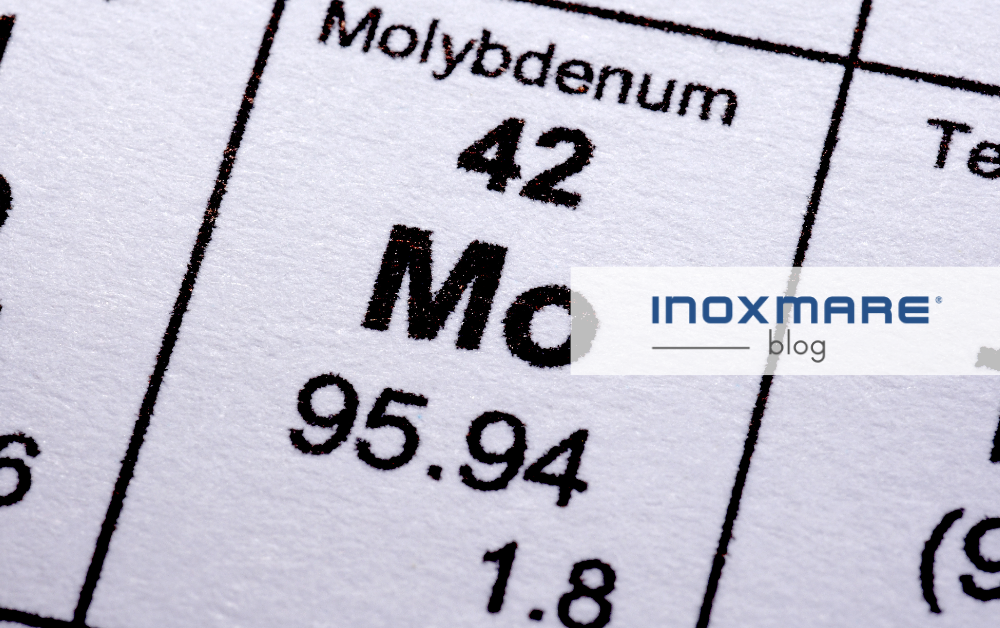
Molybdenum (symbol Mo) is considered a transition metal thanks to its atomic number 42 on the periodic table of the elements. This element, together with steel, increases:
- hardenability
- hot resistance
- hardness and wear resistance
- corrosion resistance of stainless steel in specific environments ( e.g. acids)
- mechanical resistance to high temperatures
In addition, this element prevents the tempering embrittlement and decreases the sensitivity to overheating.
How is nitrogen used?
Nitrogen (symbol N) is considered a non-metal. What are the applications of this chemical element? The nitrogen is used only in some metallurgical processes, as it is not always an element suitable to use. Indeed, this element, if subjected to high temperatures, reacts with certain metals – in some cases, this is done intentionally. Nitrogen is used in sintering and annealing of steels; Moreover, it is crucial in steel hardening in vacuum furnaces. This element is absorbed during the production process, and it is always present from 0.003% to 0.015% levels. Nitrogen encourages the phenomenon of ageing in chromium steels. How different special steels (e.g. those steels) change when adding nitrogen?
The latter is used to increase
- mechanical properties (precipitation hardening)
- corrosion resistance (pitting)
In addition, if instead of nickel nitrogen is used in biocompatible steels (all elements that are used as the materials for the construction of biomedical devices), it is able to stabilize the austenite.
Nickel: the silvery metal
Nickel (Ni) is a silvery metal and is one of four elements that are ferromagnetic at approximately room temperature. Nickel belongs to the transition metals and is hard, malleable and ductile. Together with steel, it increases
- hardenability (even slightly)
- resistance and hardness (after the heat-treat)
In addition, nickel can improve both strength/resistance and oxidation resistance to heat, as well as decreasing the sensitivity to overheating. On stainless steel, nickel helps the corrosion resistance and, at correct percentages, induces austenitic array. Moreover, the presence of nickel determines the toughness at low temperature.
Find our webshop!
Click on the link below to access to our web shop. You can choose the most suitable items to your customers needs.
Want to read more? Click here