


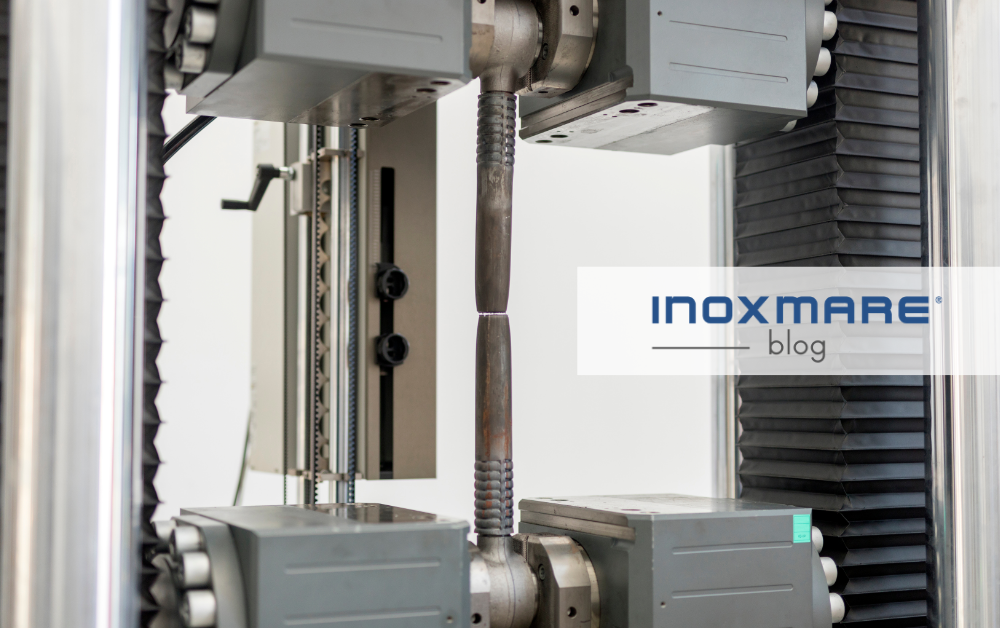
Today, in our post we want to talk about the testing methods required by standard 898-1 for fasteners. In particular, today we want to focus on all the tensile tests.
Tensile tests with oblique support of finished screw
This type of test is intended to determine simultaneously:
- The tensile strength of finished screws (Rm)
- The integrity of the transition section between
- head
- smooth or fully threaded stem
Moreover, we report that the testing with oblique support of finished screws is not related to the studs.
Tensile tests of screws and ended studs up to determining the breaking strength in traction (Rm)
This test determines the tensile breaking strenght of finished fasteners (Rm). The latter are connecting elements for which were completed all the manufacturing steps.
- with or without surface coating
- with full or reduced load capacity
- not subjected to machining to make a sample.
Tensile tests of full sized screws and studs for determination of elongation at break (Af) and minimum unit load of distance from proportionality 0,0048 d (Rpf)
What is the purpose of this test? You want to determine simultaneously:
- the elongation at break of full size fasteners (Af)
- the unit load of deviation from proportionality 0.0048 d on full size fasteners (Rpf).
Tensile tests of screws with reduced load capacity due to the head shape
With this test you can determine the tensile load for those screws where there is no break in the free threaded length due to the head shape. What is a connecting element with reduced load capacity? It is a connecting element finished:
- standardised or non- standardised
- with material properties according to classes of resistance specified in ISO 898-1
- which does not comply (due to geometry) with the requirements for the load capacity when tested.
Tensile tests of fasteners with reduced shank
The purpose of this test is to determine the tensile breaking strenght (Rm) of all those fasteners with reduced shank.
Tensile tests of sample subjected to machining
This test determines:
- the traction resistance (Rm)
- the unit load of
- lower yield strength (ReL)
- deviation from proportionality of 0,2% (Rp0,2)
- the percentage elongation at break (A)
- the necking at break (Z).
Find our webshop!
Click on the link below to access on our web shop. You can choose the most suitable items to your customers needs.
Want to read more? Click here
Good article. Keep posting like this.
Thanks!
XO